Adam (YC W25): Open Source AI CAD That Generates OpenSCAD from Text

TL;DR
A YC W25 startup open-sources CADAM, a browser-based tool that converts natural language to parametric OpenSCAD models. HN debate: is text-to-CAD genuinely useful or just another demo?
A YC W25 company called Adam launched on Hacker News yesterday with 189 points and 87 comments. They are building AI agents for mechanical CAD software. The headline: an open source text-to-CAD platform called CADAM that generates parametric OpenSCAD models from natural language.
The HN discussion got into the weeds on whether this approach is actually useful for real manufacturing workflows or just a nice demo for hobbyist 3D printing.
Last updated: June 18, 2026
What CADAM Does
CADAM is a React app that runs entirely in the browser. You describe what you want in plain English - or upload a reference image - and the system generates OpenSCAD code that compiles to a 3D model. The key differentiator from typical text-to-3D tools: it outputs parametric CAD, not meshes.
From the GitHub README:
Generates parametric 3D models from natural language, with support for both text prompts and image references. Outputs OpenSCAD code with automatically extracted parameters that surface as interactive sliders for instant dimension tweaking.
The architecture is straightforward:
- Frontend: React 19 with TanStack Start
- 3D rendering: Three.js via React Three Fiber
- CAD engine: OpenSCAD compiled to WebAssembly, running in a Web Worker
- AI: Claude API with a single agentic endpoint that switches between "parametric mode" (OpenSCAD) and "mesh mode" (textured 3D)
- Backend: Supabase for auth, database, and storage
One clever optimization: simple parameter adjustments bypass the LLM entirely. When you move a slider, the app does a deterministic regex update on the OpenSCAD source. No API call, instant feedback.
The founders note in their launch post that "surprisingly, in our evals Gemini 3.1 Pro is the top model" for this task.
The HN Debate: Useful Tool or Toy?
The discussion split into two camps.
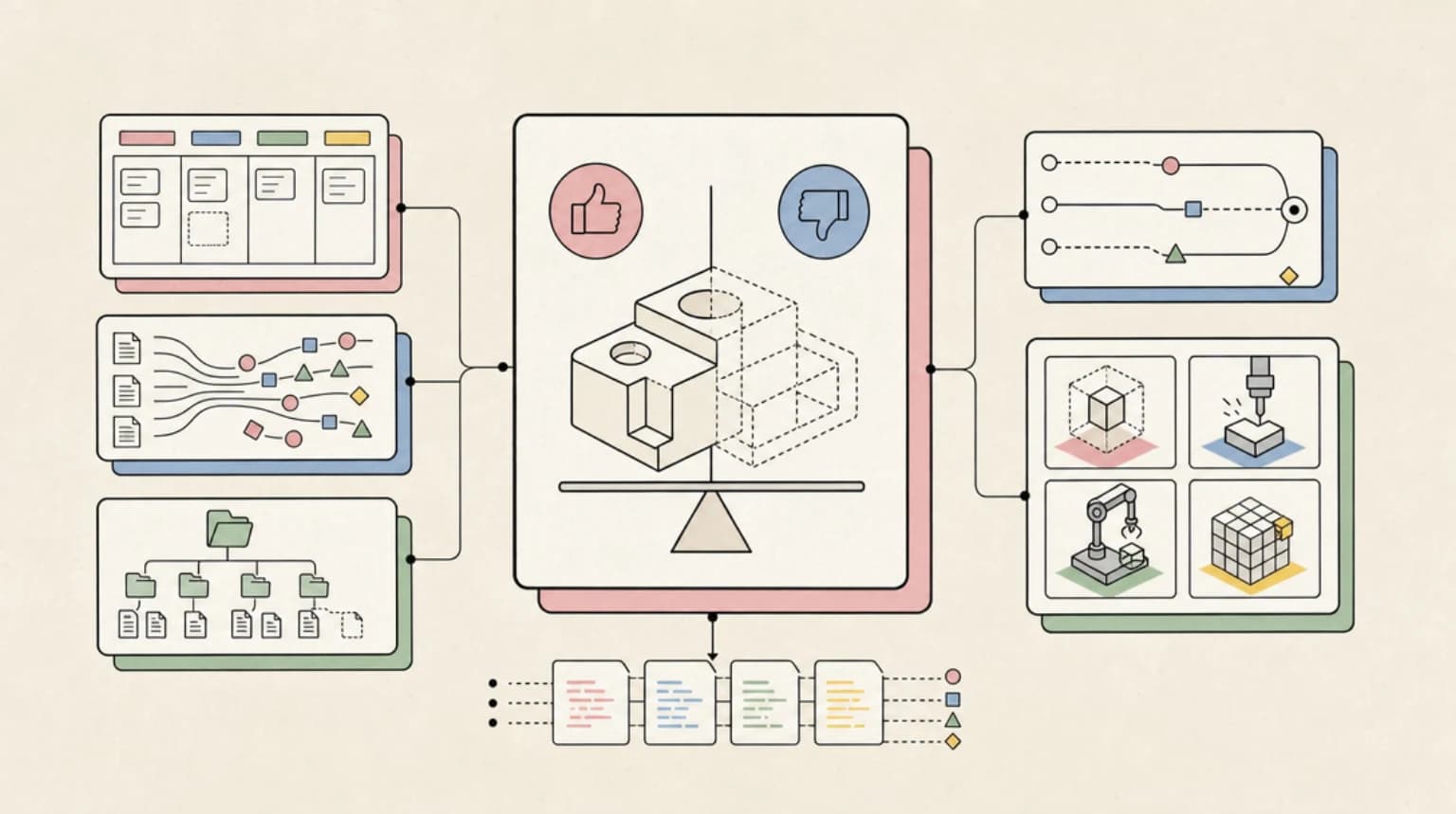
The skeptics argued that text-to-CAD solves the wrong problem. User tapia, who appears to work in CAD professionally, made the point repeatedly:
CAD is really not so complicated with the tools we currently have. You just have to learn how to use them... describing complex geometries with specific tolerances with natural language is much more complex than creating the geometry programmatically.
User q3k was blunter about the V8 engine example in the README:
Yeah, no, that is a lie. This is not a CAD model. It is a fantasy 3d model that looks like it is straight out of Gearhead Garage (1999)... Show me something functional that you have actually manufactured.
The critique: AI-generated CAD models look impressive in renders but lack the dimensional tolerances, fastener specifications, and design intent required for actual manufacturing. The V8 engine demo has cams intersecting each other and no thought given to how it would be assembled.
The optimists pushed back on the narrow framing. User dgellow defended the 3D printing use case:
The 3D print market is pretty large and tools to generate some designs that can then be tweaked are pretty useful in that context. I do not think that type of AI CAD tool would replace professional CAD work, that is something that requires way too much context and human judgement.
The founder zachdive agreed, positioning CADAM as "AI TinkerCAD" - a tool for rapid prototyping and hobbyist work, not production engineering.
Newsletter
Get the weekly deep dive
Tutorials on Claude Code, AI agents, and dev tools, delivered free every week.
From the archive
Emacs 31 is Around the Corner: The Features Worth Daily Driving
Jun 18, 2026 • 6 min read
Local Qwen Is a Different Tool, Not a Worse Opus
Jun 18, 2026 • 7 min read
Mellum2 Developer Guide: JetBrains' Open-Source Coding Model
Jun 18, 2026 • 7 min read
Midjourney Built a Full-Body Scanner: The Image-Generation Company's Strangest, Most Revealing Bet Yet
Jun 18, 2026 • 12 min read
The Legitimate Use Cases
Reading between the lines of the discussion, three use cases emerge where text-to-CAD makes sense:
Rapid prototyping. When you need a bracket, enclosure, or fixture for a one-off project, getting a starting point from a text description is faster than learning or re-learning a CAD tool. The output needs iteration, but the first draft is free.
Hobbyist 3D printing. For parts that do not need to interface with other components or meet tolerance specs, the generated models are often good enough to print directly. A custom phone stand does not need GD&T.
Education and exploration. Learning CAD is a significant time investment. Text-to-CAD lowers the barrier for people who want to explore mechanical design without committing to mastering SolidWorks or Fusion 360.
The founder mentioned that their commercial extensions for Onshape and Fusion 360 include face and edge selection context - you can select geometry and describe what you want done to it. That hybrid interface (traditional selection plus natural language) may be more practical than pure text-to-CAD for complex assemblies.
Technical Details Worth Noting
A few implementation choices stand out:
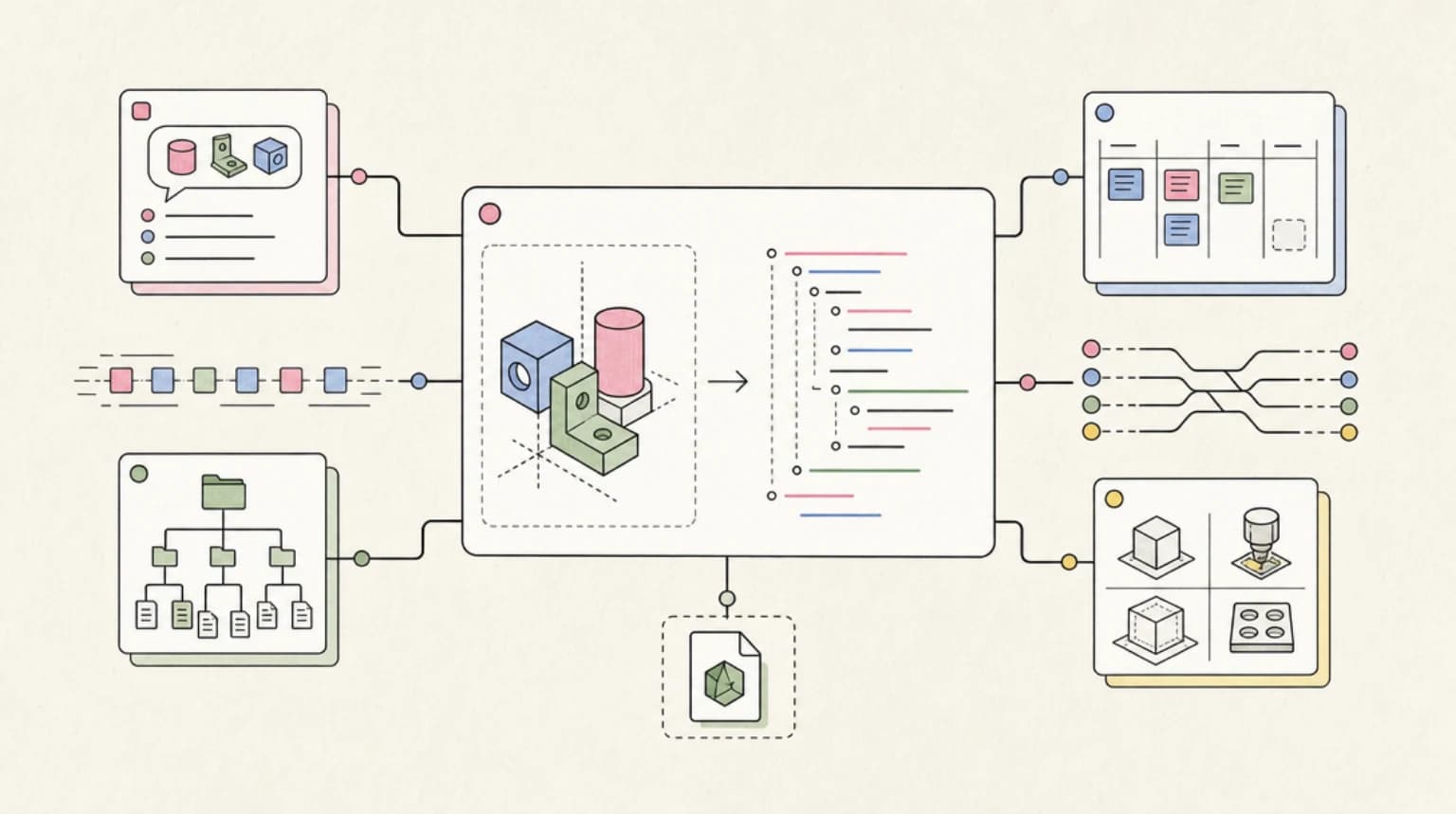
OpenSCAD as the intermediate representation. This is a deliberate choice. OpenSCAD is a code-first CAD tool - models are programs, not interactive designs. That makes it a natural fit for LLM generation. The downside: OpenSCAD uses CSG (constructive solid geometry) primitives, which are less expressive than the B-rep approaches used by professional CAD tools. The founders acknowledge this and mention plans to support build123d and CadQuery for constraint-driven modeling.
Parameters are first-class. The system extracts dimensions as named parameters that users can adjust via sliders. This is the right UX choice. Instead of regenerating the entire model for a small tweak, you adjust the parameters directly.
Model-agnostic backend. CADAM supports Claude, Gemini, and OpenAI models through OpenRouter. The Vercel AI SDK handles the routing.
GPLv3 license. The open source release is under GPL, which matters if you are thinking about commercial derivatives.
My Take
The skeptics are right that text-to-CAD is not going to replace SolidWorks for production engineering anytime soon. The gap between "looks like a V8 engine" and "can be manufactured as a V8 engine" is enormous, and natural language is a poor interface for specifying tolerances, material properties, and assembly constraints.
But the skeptics are also fighting a straw man. Nobody is claiming this replaces professional CAD workflows. The real question is whether text-to-CAD is useful for the long tail of simpler problems: brackets, enclosures, adapters, fixtures, organizers, holders, and the thousand other small parts that people design and 3D print.
For that use case, getting a parametric starting point from a sentence is genuinely valuable. You are trading precision for speed. The output is not manufacturing-ready, but it is iteration-ready.
The more interesting angle is the hybrid interface - traditional CAD selection plus natural language commands. That could make existing CAD tools more accessible without dumbing them down. Select a face, type "add a 5mm chamfer," get a valid operation. The Adam team's Fusion and Onshape extensions are exploring this direction.
Worth watching how this evolves. The underlying models are getting better at code generation, and OpenSCAD is just code.
Sources
- CADAM GitHub Repository - Open source codebase
- Hacker News Launch Discussion - 87 comments, 189 points
- Adam Website - Commercial product and Onshape/Fusion extensions
- OpenSCAD Documentation - The underlying CAD language
Read next
Open Design Shows the Next Agent Wrapper
Open Design is trending because it turns Claude Code, Codex, Cursor, Gemini, and other CLIs into a design engine. The useful lesson is not design automation. It is artifact-first agent wrappers.
8 min readVibe Coding in 2026: Build Fast Without Losing the Plot
Vibe coding works when you pair natural-language building with repo context, tests, diff review, security checks, and rollback. Here is the practical workflow for Claude Code, Cursor, Codex, v0, Lovable, and Bolt.
10 min readBest AI Coding Tools June 2026: Updated After Fable 5 Changes Everything
Fable 5 landed on June 9, GitHub Copilot rewired its billing on June 1, and the tool-stack decisions you made in Q1 may need a rethink. Here is where every major coding tool stands right now.
9 min readShare
Suggest an editSave
Developers Digest
Technical content at the intersection of AI and development. Building with AI agents, Claude Code, and modern dev tools - then showing you exactly how it works.
300+ videos30K+ GitHub stars50+ articles
Related Tools
AI Coding
Kimi Code
Open-source terminal coding agent from Moonshot AI. Powered by Kimi K2.5 (1T params, 32B active). 256K context window. A...
View ToolAI CodingFree
Gemini CLI
Google's open-source coding CLI. Free tier with Gemini 2.5 Pro. Supports tool use, file editing, shell commands. 1M toke...
View ToolAI Models
DeepSeek
Open-source reasoning models from China. DeepSeek-R1 rivals o1 on math and code benchmarks. V3 for general use. Fully op...
View ToolAI Models
Qwen3-Coder
Alibaba's flagship open-weight coding model. 480B total parameters, 35B active (MoE). Native 256K context, scales to 1M....
View ToolApps from Developers Digest
Developer ToolsIn Progress
Maintainer Dashboard
Track open-source maintenance signals, release tasks, and repo follow-ups in one dashboard.
View AppDeveloper Tools
Voice
Talk, get text. A Mac dictation app that doesn't waste your words.
View AppDirectoriesIn Progress
AI Tool Radar
Track fast-moving AI tools, releases, pricing, and docs from one product intelligence dashboard.
View AppRelated Guides
Guide
Building Your First MCP Server
Step-by-step guide to building an MCP server in TypeScript - from project setup to tool definitions, resource handling, testing, and deployment.
AI AgentsGuide
Prompt Suggestions - Claude Code
Context-aware follow-up suggestions derived from git history.
Claude CodeGuide
Migrating from Cursor to Claude Code
A concrete step-by-step guide to moving your development workflow from Cursor to Claude Code - settings, rules, keybindings, and the habits that transfer.
Getting StartedRelated Videos
Unstract: AI Document Parser: Extract Data from Complex PDFs at Scale! (Open Source)
In this video, I introduce Unstract, an AI-powered no-code platform for automating the processing of large unstructured documents like PDFs, images, and scanned files. I discuss the challenges...
Video·
Zed: The Open Source Agentic IDE - Use Claude Code, Codex & Gemini CLI in one place
Check out Zed here! https://zed.dev In this video, we dive into Zed, a robust open source code editor that has recently introduced the Agent Client Protocol. This new open standard allows...
Video·
NVIDIA's NEW Open Source Nemotron Nano 2 VL Model in 5 Minutes
NVIDIA just released Nemotron Nano 2 VL - an open-source vision language model that's 4x more efficient than previous models. In this video, I break down what makes this 12-billion parameter...
Video·
Related Posts

8 min read
AI Coding
Open Design Shows the Next Agent Wrapper
Open Design is trending because it turns Claude Code, Codex, Cursor, Gemini, and other CLIs into a design engine. The us...
10 min read
Vibe Coding
Vibe Coding in 2026: Build Fast Without Losing the Plot
Vibe coding works when you pair natural-language building with repo context, tests, diff review, security checks, and ro...

9 min read
AI Coding Tools
Best AI Coding Tools June 2026: Updated After Fable 5 Changes Everything
Fable 5 landed on June 9, GitHub Copilot rewired its billing on June 1, and the tool-stack decisions you made in Q1 may...

9 min read
Claude Code
How I'm Building 24 AI-Powered Apps in Parallel
One dev, one CLI, 24 subdomains, and a lot of parallel agents. The playbook for shipping an AI app portfolio.
6 min read
News
Ternlight: A 7 MB Embedding Model That Runs Entirely in the Browser
Ternlight ships a ternary-quantized sentence encoder at 7 MB that runs semantic search at 5ms per embedding - entirely c...
6 min read
News
Kokoro: Local, CPU-Friendly TTS That Actually Sounds Good
An 82M parameter text-to-speech model that runs on CPU and produces high-quality speech across multiple languages - no c...
Build with the member tools
Get Smarter About AI Dev
New tutorials, open-source projects, and deep dives on coding agents - delivered weekly.
One email per weekReal code, not theoryFree forever