Apertus: Europe's Answer to AI Sovereignty - and Why HN Is Skeptical
TL;DR
Switzerland's fully open foundation model promises transparent training data and EU compliance. The HN crowd has questions about actual performance.
Last updated: June 24, 2026
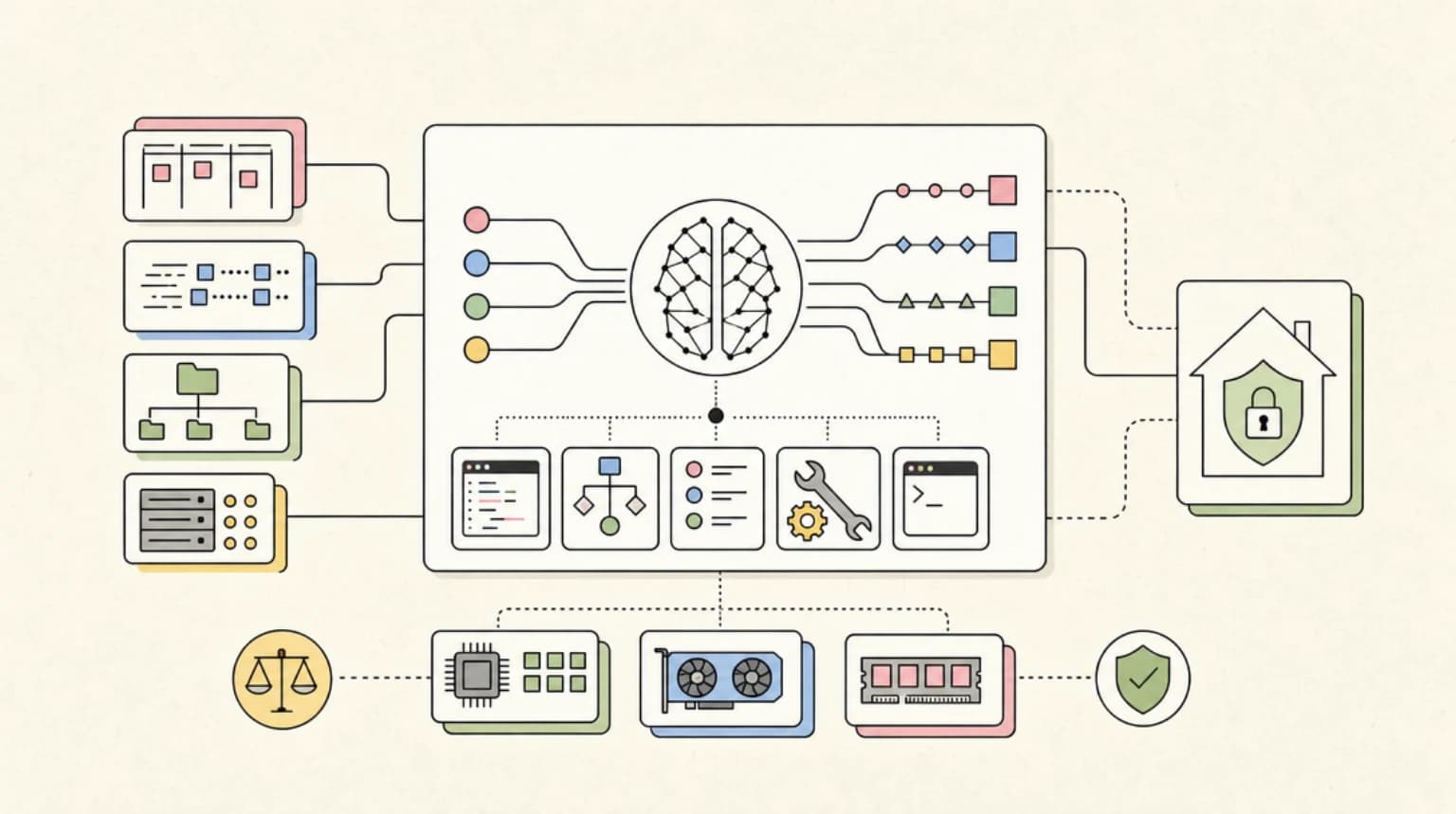
The Swiss AI Initiative just shipped Apertus, a fully open foundation model developed by EPFL, ETH Zurich, and the Swiss National Supercomputing Centre (CSCS). The pitch: complete transparency, EU AI Act compliance, and training data you can actually inspect.
The Hacker News response has been complicated. Developers like the ambition, but they are asking the same practical question that follows every open model launch: how much capability are you giving up for transparency?
What Apertus Actually Is
Apertus ships in two sizes - 8B and 70B parameters - trained on 15 trillion tokens across 1,000+ languages. The headline differentiator is openness: training data, code, weights, methods, and alignment principles are all documented and reproducible.
From the official site:
Fully open model: open weights + open data + full training details including all data and training recipes.
The model was trained on CSCS's Alps supercomputer using up to 4,096 GPUs. Swisscom serves as the strategic partner, and you can access it through Hugging Face or the Public AI network.
Key claims:
- Built to meet EU AI Act requirements
- Respects opt-outs and removes PII
- Prevents memorization
- Competitive with top open models at equivalent scales
What HN Is Saying
The HN discussion splits into a few camps:
The "Actually Open" Appreciation
The core appeal is scientific reproducibility. Several commenters treated Apertus less as a leaderboard play and more as infrastructure for research: a model where training data, recipes, methods, and weights are visible enough to audit.
Several users pointed out that Apertus joins a small club of genuinely open models - alongside Allen AI's OLMo 3.1, MBZUAI's K2 Think V2, and Nvidia's Nemotron (though Nemotron has some proprietary data).
The Performance Question
The most upvoted criticism is simple: is the model actually good?
Artificial Analysis now has dedicated pages for Apertus 8B Instruct and Apertus 70B Instruct, and the takeaway is not flattering on raw intelligence rankings. That does not invalidate the openness story, but it does make the tradeoff explicit: transparency is the product, not frontier capability.
The multilingual claims also drew skepticism from hands-on users. The safer read is that broad language coverage is a research and sovereignty win, while practical quality still needs task-by-task evaluation.
The Training Data Debate
This is where things get philosophically interesting. Simon Willison noted that Apertus "uses fineweb, which is derived from Common Crawl, which is an unlicensed scrape of web pages."
This prompted a subthread about whether "sovereign AI" can really claim ethical high ground while using web-scale scraped corpora. One side argues public web analysis is legitimate and necessary. The other argues that transparency about scraping does not answer compensation or consent concerns. Apertus is useful here because it makes the debate inspectable instead of hiding it behind a closed training stack.
The Geopolitical Angle
Several comments touched on why European AI independence matters. The argument is straightforward: even if Apertus is not state-of-the-art today, European-controlled AI infrastructure matters for data sovereignty, public-sector procurement, language coverage, and regulatory compliance.
Newsletter
Get the weekly deep dive
Tutorials on Claude Code, AI agents, and dev tools, delivered free every week.
From the archive
Claude Code's Extended Thinking Is a Summary - What That Means for You
Jun 22, 2026 • 5 min read
Codex CLI Needs Resource Budgets, Not Just Token Budgets
Jun 22, 2026 • 8 min read
Codex Logging Bug Can Write Terabytes to Your SSD
Jun 22, 2026 • 5 min read
Deno Desktop Lets You Build Native Apps with TypeScript
Jun 22, 2026 • 8 min read
The Practical Takeaway
If you're evaluating Apertus for production use, here's what the evidence suggests:
Strengths:
- Full training transparency - you can audit everything
- EU AI Act compliance baked in
- No licensing restrictions for commercial use
- Multilingual training with underrepresented languages (Swiss German, Romansh)
Weaknesses:
- Performance lags behind Nemotron, DeepSeek, and frontier models
- Not ready for agentic use cases according to hands-on reports
- Multilingual quality is inconsistent in practice
Best use cases:
- RAG applications where transparency matters more than peak performance
- European organizations with strict data sovereignty requirements
- Research where reproducibility is the priority
That makes Apertus adjacent to the local/open-model lane rather than the frontier-agent lane. If you are choosing models for coding agents, start with the best local coding LLMs, Cohere North Mini Code, GLM-5.2 local deployment, or DeepSeek V4 budget coding agents. If you are choosing models for transparency, auditability, or public-sector sovereignty, Apertus enters the shortlist.
The Bigger Picture
The debate in this thread mirrors a broader tension in AI development: should we prioritize transparency and ethical sourcing even at the cost of capability? Or does "open" only matter if the model is actually competitive?
For now, Apertus represents a credible attempt at the transparency-first approach. Whether the capability gap closes depends on continued funding and research. The Swiss AI Initiative has the institutional backing - EPFL and ETH Zurich are serious players - but catching up to labs spending billions requires more than good intentions.
If you want a model where you can trace every training decision, Apertus delivers. If you need frontier performance, you're still looking at Nemotron, DeepSeek, or the closed models.
The market has room for both. In practice, most teams should treat this as a routing decision: use transparency-first models where auditability matters, and route high-difficulty work to stronger models when quality is the binding constraint. That is the same operational pattern behind local Qwen as a different tool, VibeThinker small-model routing, and AI affordability as cost accounting.
FAQ
Is Apertus fully open?
It is one of the stronger openness claims in the model market: the project emphasizes open weights, open data documentation, training details, methods, and recipes. That is different from many "open-weight" models where the weights ship but the data and training process remain opaque.
Is Apertus good enough for production?
It depends on the job. The practical evidence points toward transparency-first RAG, public-sector experimentation, multilingual research, and audit-heavy workflows. For frontier coding agents or general high-stakes reasoning, benchmark and hands-on reports suggest stronger models are still ahead.
Why does Apertus matter if it is not the strongest model?
Because sovereignty and reproducibility are product requirements for some teams. A weaker but inspectable model can be more useful than a stronger closed model when procurement, compliance, language coverage, or research reproducibility matters.
Where can developers try Apertus?
Start with the official Apertus site and documentation, then check the Swiss AI organization on Hugging Face. Availability and hosted routes may change, so verify the current model card and license before building around it.
Sources
Read next
GLM 5.2 and the AI Margin Collapse Thesis
Martin Alderson's argument for why open-weights models like GLM 5.2 will compress frontier lab margins is sparking debate on HN. Here is what the thesis actually says, where HN agrees and disagrees, and why it matters for developers choosing models.
7 min readGodot Bans AI-Authored Code Contributions - What It Means for Open Source
The Godot Foundation has established a policy banning autonomous AI agent code and substantial AI-generated contributions, citing reviewer burnout and concerns about maintainer mentorship.
6 min readGPT-5.5 Has a 3x Higher Hallucination Rate Than MIT-Licensed GLM-5.2
New benchmark data shows GPT-5.5 hallucinates 86% of the time when it does not know the answer - versus 28% for the open-weights GLM-5.2. The numbers challenge the assumption that bigger models equal more reliable output.
6 min readShare
Suggest an editSave
Developers Digest
Technical content at the intersection of AI and development. Building with AI agents, Claude Code, and modern dev tools - then showing you exactly how it works.
300+ videos30K+ GitHub stars50+ articles
Apps from Developers Digest
Related Guides
Related Posts
6 min read
News
Kokoro: Local, CPU-Friendly TTS That Actually Sounds Good
An 82M parameter text-to-speech model that runs on CPU and produces high-quality speech across multiple languages - no c...
5 min read
News
Better Auth Joins Vercel: What It Means for the Auth Ecosystem
Vercel acquires the open-source authentication framework that became the go-to Next.js auth solution. HN weighs in on op...
7 min read
News
GLM 5.2 and the AI Margin Collapse Thesis
Martin Alderson's argument for why open-weights models like GLM 5.2 will compress frontier lab margins is sparking debat...
6 min read
News
Ternlight: A 7 MB Embedding Model That Runs Entirely in the Browser
Ternlight ships a ternary-quantized sentence encoder at 7 MB that runs semantic search at 5ms per embedding - entirely c...
8 min read
News
AI Tutor Shows 0.71-1.30 SD Effect Size in Dartmouth Statistics Course
A new study from Dartmouth measures the impact of an AI tutoring platform on introductory statistics performance. Full e...
8 min read
AI Research
Anthropic Discovers J-Space: A Global Workspace Inside Language Models
Anthropic's new research reveals LLMs have an internal 'workspace' for silent reasoning - and it could change how we bui...
Build with the member tools
Get Smarter About AI Dev
New tutorials, open-source projects, and deep dives on coding agents - delivered weekly.
One email per weekReal code, not theoryFree forever