Goose: The Open Source AI Agent With 70+ MCP Extensions
TL;DR
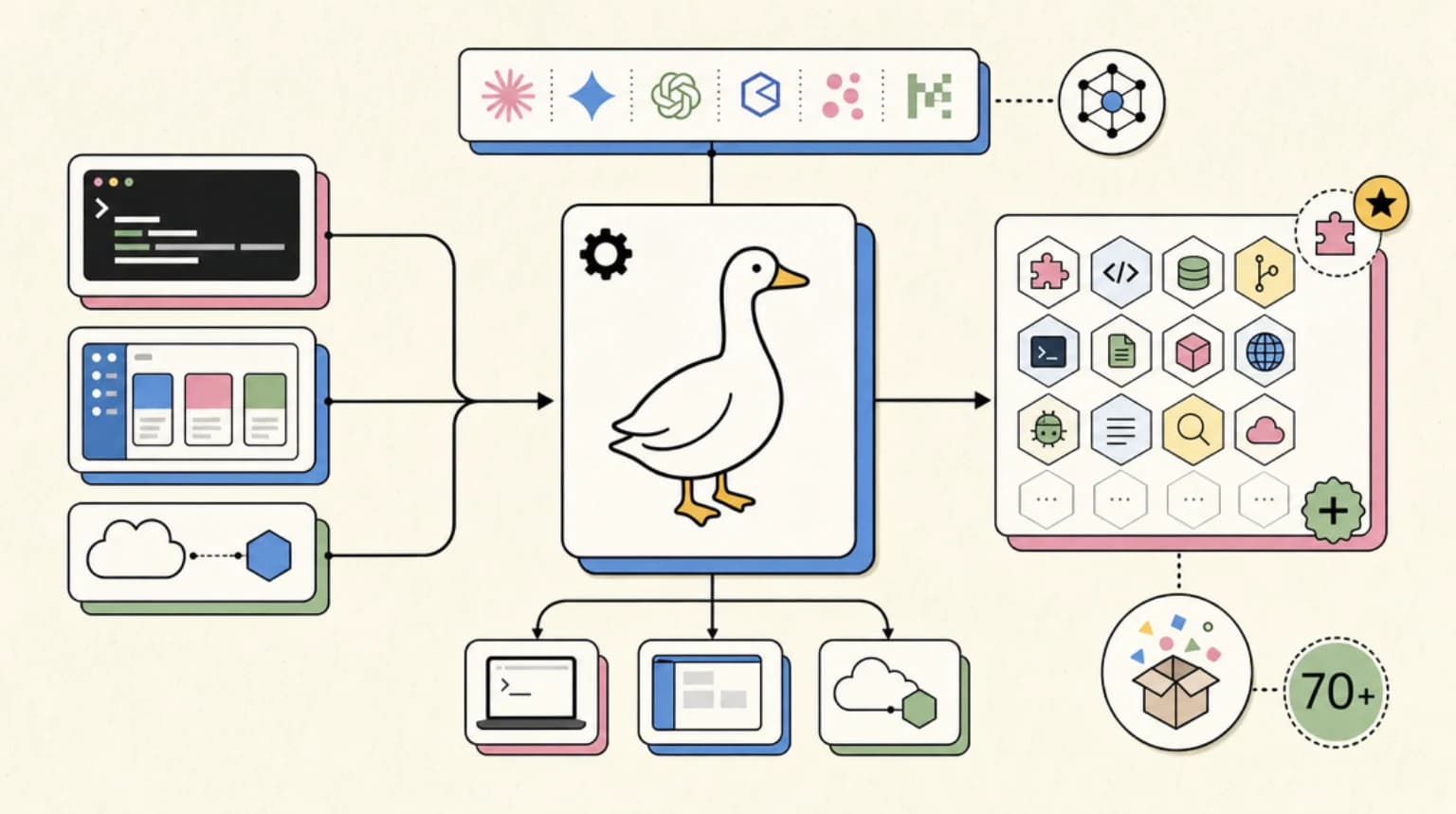
Goose is a Rust-built AI agent with a CLI, desktop app, and API that runs against 15+ LLM providers and extends through 70+ MCP extensions - here is why developers are installing it.
Goose is one of the more useful open-source agent projects to watch because it is not trying to be another editor sidebar. It is a native local agent runtime with a desktop app, a CLI, and an API surface, built in Rust and designed to work across model providers.
Last updated: June 24, 2026
The project now lives at aaif-goose/goose after moving from Block to the Agentic AI Foundation at the Linux Foundation. The old block/goose repository redirects to the new home, and the GitHub API currently shows the project above 50,000 stars with an Apache-2.0 license.
That combination matters: Goose is popular, local, open source, provider-neutral, and built around the Model Context Protocol. If you care about terminal agents becoming portable runtime surfaces, Goose is one of the cleanest examples of that pattern.
What Goose Actually Is
The README describes Goose as a general-purpose AI agent that runs on your machine. It is not only for code. The project positions it for research, writing, automation, data analysis, and workflow execution.
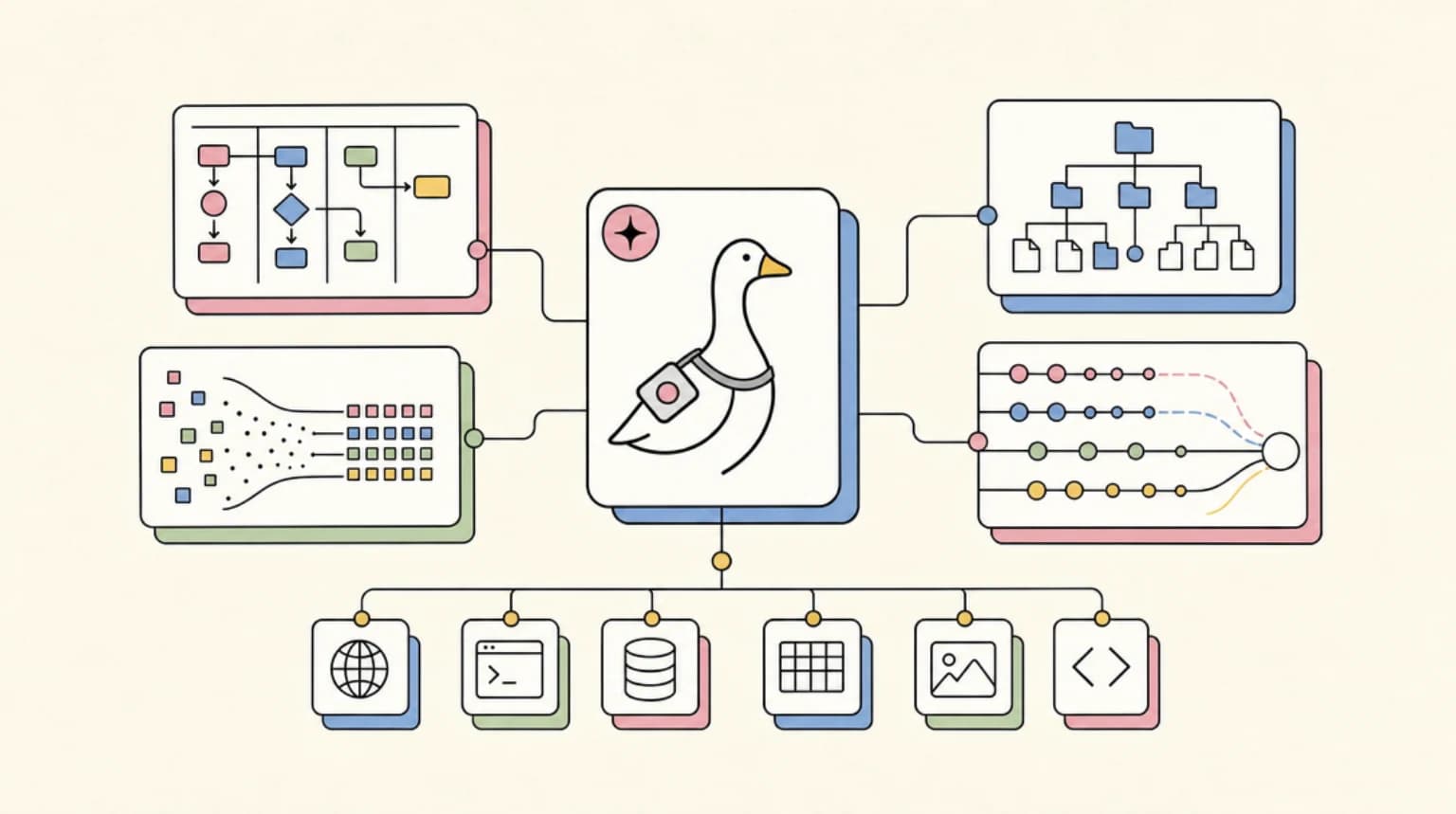
The core surfaces are:
- Desktop app for macOS, Linux, and Windows
- CLI for terminal workflows
- API for embedding Goose into other systems
- MCP extensions for connecting tools and data sources
- Provider support across Anthropic, OpenAI, Google, Ollama, OpenRouter, Azure, Bedrock, and more
That shape makes Goose different from a tool like Cursor or Claude Code. It can help with coding, but it is not locked to an IDE workflow. It is closer to a local automation layer that can read files, run commands, call tools, edit code, and continue a multi-step task.
If local coding agent workspaces are becoming the new IDE surface, Goose is the open-source runtime version of that argument.
Why The MCP Extension Model Matters
Goose's biggest strategic advantage is its extension layer. The project says it connects to 70+ extensions through MCP, which means the integration work is not trapped inside Goose.
MCP is becoming the shared tool protocol across agent clients. We have covered it in the MCP primer and the complete MCP server guide, but the short version is this: MCP lets an agent client call external tools through a standard protocol instead of every tool inventing its own plugin system.
For Goose, that means a file tool, database tool, internal API tool, or browser control tool can become part of the same session model. For teams, it means the work invested in MCP servers can compound across Goose, Claude Code, Cursor, OpenAI clients, and other runtimes.
That is why Goose is more interesting than the star count. Stars are a popularity signal. MCP compatibility is the portability signal.
Newsletter
Get the weekly deep dive
Tutorials on Claude Code, AI agents, and dev tools, delivered free every week.
From the archive
Harness Engineering Makes Tokens a Systems Budget
Jun 7, 2026 • 8 min read
LLM Routers Compared: LiteLLM vs Portkey vs OpenRouter in 2026
Jun 7, 2026 • 10 min read
AI Code Attribution Needs Defect Forensics, Not Vibes
Jun 6, 2026 • 8 min read
Security Agents Need Repro Harnesses, Not More Scan Prompts
Jun 5, 2026 • 9 min read
Provider Neutrality Is The Real Selling Point
The Goose README lists support for 15+ providers and specifically mentions Anthropic, OpenAI, Google, Ollama, OpenRouter, Azure, and AWS Bedrock. It also points to ACP support for using existing Claude, ChatGPT, or Gemini subscriptions.
That matters because agent workflows should not be permanently welded to one model vendor. The right model for a repo-wide refactor may be different from the right model for log summarization, local file cleanup, or a cheap background research pass.
This is the same direction behind OpenRouter-style routing, local model workflows, and Claude Code vs Codex vs Cursor vs OpenCode. The durable value is not only the chat UI. It is the harness around the model: tools, memory, permissions, logs, execution, and repeatable workflow.
Goose gives developers a way to keep that harness local and open.
Installing Goose
The CLI install path from the current README is:
curl -fsSL https://github.com/aaif-goose/goose/releases/download/stable/download_cli.sh | bash
The project also links to desktop app downloads through its documentation site. After installation, you configure a model provider, then run tasks through the CLI or desktop app.
The right first test is not "rewrite this whole codebase." Start smaller:
- Ask Goose to summarize a project directory.
- Ask it to make a tiny change and run the relevant test.
- Add one MCP extension.
- Repeat the same task with a different provider.
- Check the logs and diffs before trusting it with larger work.
That sequence tells you more than a demo video. It tests local file access, command execution, provider configuration, tool calling, and error recovery.
Where Goose Fits Beside Claude Code And OpenCode
Goose is not automatically better than Claude Code, Codex, OpenCode, or Cursor. It is useful in a different lane.
Use Goose when you want:
- A local open-source agent runtime
- Model-provider flexibility
- MCP extension portability
- A desktop plus CLI workflow
- A runtime you can inspect and modify
Use Claude Code or Codex when you want a deeply integrated coding-agent loop with first-party model behavior, managed session ergonomics, or cloud-agent coordination. Use Cursor when the editor is the center of the workflow. Use OpenCode when you want a terminal-native, provider-flexible coding loop with a different interaction model.
The point is not to pick one forever. The better pattern is to build agent workspace contracts that let multiple agents operate safely in the same repo: clear permissions, scoped files, test commands, logs, and rollback.
Governance And Production Reality
The AAIF and Linux Foundation move is a good signal, but it does not remove the normal operational questions.
If you plan to use Goose inside team workflows, check:
- How provider credentials are stored
- Which MCP extensions can access sensitive systems
- Whether command execution requires confirmation
- Where logs and transcripts live
- How you recover from a bad file edit
- Whether the extension you need is maintained
Open source makes inspection possible. It does not make the workflow safe by default.
That is why I would treat Goose as a strong candidate for non-critical automation, local research, repo analysis, and repeatable agent experiments before putting it in a production deployment path. It is powerful enough to be useful and young enough that teams should still wrap it with receipts.
The Takeaway
Goose is worth tracking because it points at the next phase of open-source agents: local runtimes that are not tied to one editor, one model vendor, or one tool marketplace.
The interesting question is not "can Goose edit code?" Many agents can. The interesting question is whether Goose can become a stable local harness for MCP tools, provider routing, and repeatable workflows.
That is the part to watch.
FAQ
What is Goose?
Goose is an open-source AI agent runtime with a desktop app, CLI, and API. It runs locally, supports multiple LLM providers, and extends through Model Context Protocol integrations.
Is Goose still a Block project?
The repository moved from Block to aaif-goose/goose under the Agentic AI Foundation at the Linux Foundation. The old block/goose GitHub path redirects to the new repository.
How is Goose different from Claude Code?
Claude Code is a first-party Anthropic coding-agent workflow. Goose is an open-source, provider-neutral local agent runtime. Goose can use Anthropic models, but it is designed to work across many providers and MCP extensions.
Is Goose production ready?
Goose is useful for local automation, repo analysis, and agent experiments, but teams should still wrap it with credential controls, command permissions, logs, and rollback before using it in workflows with production consequences.
Sources
Read next
DeepSeek-TUI: The Rust Terminal Coding Agent With MCP, Skills, and 1M-Token Context
DeepSeek-TUI is a Rust-built terminal coding agent wrapping the DeepSeek V4 API with full tool use, MCP server support, a composable skills system, and three operational modes for different risk tolerances.
6 min readHeadroom: Compress Agent Tool Output Before It Reaches the LLM
Headroom is a context compression layer that intercepts your AI agent's tool outputs and strips 60-95% of the tokens before they hit the model - with benchmarked accuracy preserved.
8 min readOpenCode Developer Guide: The Open Source AI Coding Agent with 160K Stars
OpenCode is the fastest-growing open-source AI coding agent - 160K GitHub stars, 7.5M monthly users, 75+ model providers. Here is how to set it up, configure models, and use it effectively in your workflow.
11 min readShare
Suggest an editSave
Developers Digest
Technical content at the intersection of AI and development. Building with AI agents, Claude Code, and modern dev tools - then showing you exactly how it works.
300+ videos30K+ GitHub stars50+ articles
Related Tools
AI CodingOpen source
Goose
Open-source AI agent built in Rust, now governed by the Agentic AI Foundation at the Linux Foundation. Desktop app, CLI,...
View ToolAI CodingOpen source
DeepSeek-TUI
Open-source terminal agent runtime with approval modes, rollback snapshots, MCP servers, LSP diagnostics, and a headless...
View ToolAI Coding
Codex CLI
OpenAI's open-source terminal coding agent built in Rust. Runs locally, reads your repo, edits files, and executes comma...
View ToolAI Coding
Cline
Open-source autonomous coding agent inside VS Code. Creates files, runs commands, and can use a browser for UI testing a...
View ToolApps from Developers Digest
Developer ToolsPlus $20/mo
TraceTrail Plus
Share agent traces with a link. Keep history long enough to find the bug.
View AppSaaS Products
Overnight Agents
Spec out AI agents, run them overnight, wake up to a verified GitHub repo.
View AppSaaS Products
Agent Generator
Do a task once with AI, get a reusable agent forever.
View AppRelated Guides
Guide
Building Your First MCP Server
Step-by-step guide to building an MCP server in TypeScript - from project setup to tool definitions, resource handling, testing, and deployment.
AI AgentsGuide
Git Integration - Claude Code
Stage, commit, branch, and open PRs without leaving the session.
Claude CodeGuide
AGENTS.md - Claude Code
Define custom subagent types within your project's memory layer.
Claude CodeRelated Videos

Buzz: Open-Source Collaboration for Humans + AI Agents
Buzz by Block: Open-Source Slack-Style Collaboration for Humans + AI Agents (Demo & Setup) Check out Arcade: https://arcade.dev.plug.dev/xiDRwlA Repo: https://github.com/block/buzz The video introd...
Video·
Agents 101: How to Build and Deploy Anything with AI Agents
Build Anything with Vercel, the Agentic Infrastructure Stack Check out Vercel: https://vercel.plug.dev/cwBLgfW The video shows a behind-the-scenes walkthrough of how the creator rapidly builds and d...
Video·
Nimbalyst: The Open-Source Visual Workspace for Building with Codex and Claude Code
Nimbalyst Demo: A Visual Workspace for Codex + Claude Code with Kanban, Plans, and AI Commits Try it: https://nimbalyst.com/ Star Repo Here: https://github.com/Nimbalyst/nimbalyst This video demos N...
Video·
Related Posts
6 min read
Trending
DeepSeek-TUI: The Rust Terminal Coding Agent With MCP, Skills, and 1M-Token Context
DeepSeek-TUI is a Rust-built terminal coding agent wrapping the DeepSeek V4 API with full tool use, MCP server support,...
8 min read
Trending
Headroom: Compress Agent Tool Output Before It Reaches the LLM
Headroom is a context compression layer that intercepts your AI agent's tool outputs and strips 60-95% of the tokens bef...
6 min read
Trending
CLI-Anything Turns Any Software Into an Agent-Ready Command Line
HKUDS/CLI-Anything hit 40,000 stars by solving a stubborn gap: most desktop software has no interface AI agents can reli...
7 min read
News
GitLost: How Researchers Tricked GitHub's AI Agent Into Leaking Private Repos
Security researchers discovered a prompt injection vulnerability in GitHub's Agentic Workflows that allows attackers to...

6 min read
News
Astro 7.0: Rust Compiler, Vite 8, and Up to 61% Faster Builds
Astro 7.0 rewrites core components in Rust, upgrades to Vite 8 with Rolldown, and delivers significant performance gains...
7 min read
AI Agents
Harness Engineering and the Path to Self-Improving AI
Lilian Weng argues self-improving AI won't start with models rewriting their weights - it starts with the harness. Her...
Build with the member tools
Get Smarter About AI Dev
New tutorials, open-source projects, and deep dives on coding agents - delivered weekly.
One email per weekReal code, not theoryFree forever