Program-as-Weights Turns Prompts Into Local Fuzzy Functions
The Program-as-Weights paper is a useful signal for developers: some LLM calls may move from per-request API prompts into compact local artifacts that behave like reusable fuzzy functions.
10 articles

An 82M parameter text-to-speech model that runs on CPU and produces high-quality speech across multiple languages - no cloud APIs or GPU required.

The Program-as-Weights paper is a useful signal for developers: some LLM calls may move from per-request API prompts into compact local artifacts that behave like reusable fuzzy functions.

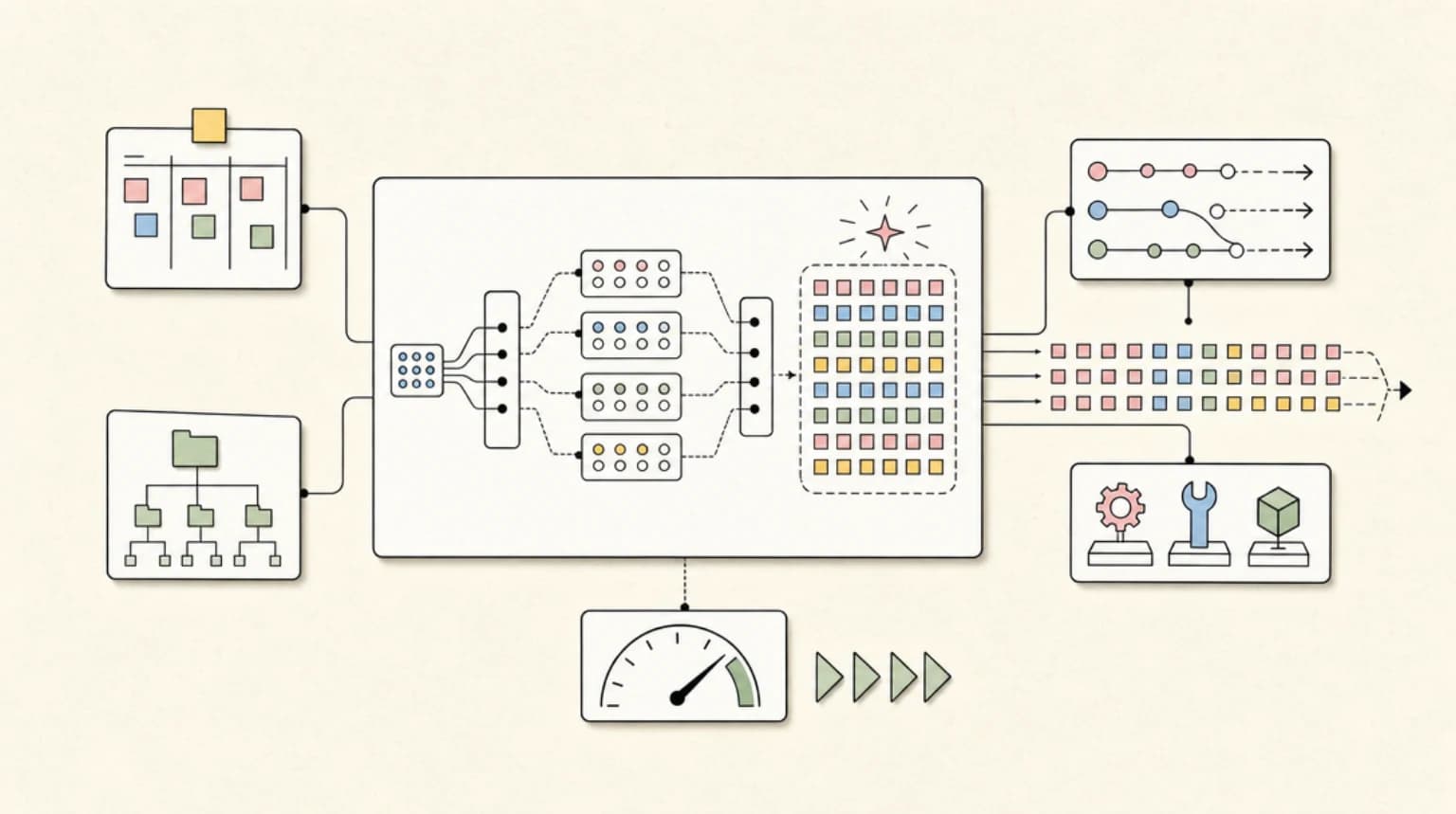
Unsloth's dynamic quantization makes GLM-5.2 runnable on a 256GB Mac or a 24GB GPU with CPU offloading. Here is the hardware math, the quantization tradeoffs, and what the HN community learned from actually running it.

Google released DiffusionGemma today, a 26B MoE open model that generates entire 256-token blocks in parallel instead of one token at a time. Here is what that means for latency, local inference, and the post-autoregressive landscape.

Cline is a free, open-source VS Code extension that brings autonomous AI coding to your editor. It works with local models or cloud APIs, handles multi-file changes, and runs terminal commands without proprietary lock-in.

A Show HN PDF form demo points at a bigger architecture shift: keep sensitive documents local, expose narrow browser tools to the model, and make AI assistance inspectable.

DeepSeek's R1 and V3 models deliver frontier-level performance under an MIT license. Here's how to use them through the API, run them locally with Ollama, and decide when they beat closed-source alternatives.

Meta's Llama 4 family brings mixture-of-experts to open source with Scout and Maverick. Here's how to run them locally, access them through APIs, and decide when they beat the competition.

NVIDIA's Nemotron Nano 9B V2 delivers something rare: a small language model that doesn't trade capability for speed. This 9B parameter model outperforms Qwen 3B across instruction following, math,...

Microsoft's PHI-4 is an MIT-licensed 14 billion parameter model that matches Llama 3.3 70B and Qwen 2.5 72B on key benchmarks. Here is what makes it special, how to run it locally, and why small language models are increasingly practical for real development work.
Showing 9 of 9 articles

New tutorials, open-source projects, and deep dives on coding agents - delivered weekly.
Explore 688 topics
Browse All Topics